You don’t need a florist or even a special vase to make your table feel beautiful. A good market bouquet is already most of the way there.
We would love for you to purchase a market bouquet from The Bloomstead, but really, a market bouquet that you love even from the grocery store will work just fine.
If you have the confidence you can build your bouquet, but often a simple market bouquet works just as well. A market bouquet is already curated for colour and texture, and it comes with stems long enough to offer flexibility in what container you choose.
Alright, you’ve got your bouquet chosen. You’ve fallen in love with the colours, or the mix of flowers, or maybe there’s one or two blooms in particular that caught your eye. This is a great start.
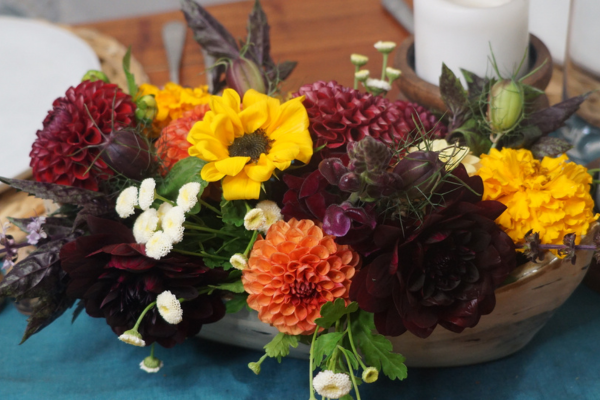
Use a Container You Already Love
Before you run out to Homesense or even the thrift shop, look around your home.
Some of the prettiest centrepieces aren’t made in vases at all. A pottery bowl or enamel pitcher, vintage teapot, wooden box with jars tucked inside, mixing bowl, or even a favourite coffee mug might lend the feel you’re looking for more than a traditional vase.
My favourite vessels to make centrepiece arrangements in are an enameled dutch oven in the shape of a pumpkin (I just remove the lid), and a ceramic birch bark-like canoe I purchased from the Pottery Guild at Goods and Co. I’ve also used empty mason jars and even beer glasses.
Just remember, if this is for your table, the general rule is to keep the flowers low enough that guests can see each other over the top. Also, think about table size. A standard six or eight seat table probably only needs one simple arrangement. If you’re setting a long harvest table, perhaps more than one arrangement, or a long narrow vessel is needed to fit the scale of the table. You decide.
The Vessel You Most Want To Use Has A Wide Opening
Don’t panic. This is where chicken wire becomes your secret weapon. A small roll of chicken wire can be found at Canadian Tire, most hardware stores, garden centres, or even in the craft section of some dollar stores. You don’t need very much.
Chicken wire is my choice because it’s inexpensive, reusable, and disappears completely inside the vessel you’re arranging in. Cut a piece of chicken wire slightly larger than the opening. Loosely scrunch the wire into a ball (tucking in all the pokey bits) so that it fits snug enough inside the vessel to hold your stems. (the more stems you add, the more secure it becomes)
If you don’t use some kind of support system inside a wide-mouth container, the stems are not going to sit where you want them to and you’ll need an enormous amount of flowers to fill the hole.
No chicken wire? There are plenty of other clever ways to support stems if you look around your kitchen or craft drawer. The principle is the same: create something inside the vessel that gives the stems somewhere to rest.
Make sure your vessel is clean. Add clean, cold water and your packet of flower food. Now for the fun part: the flowers.
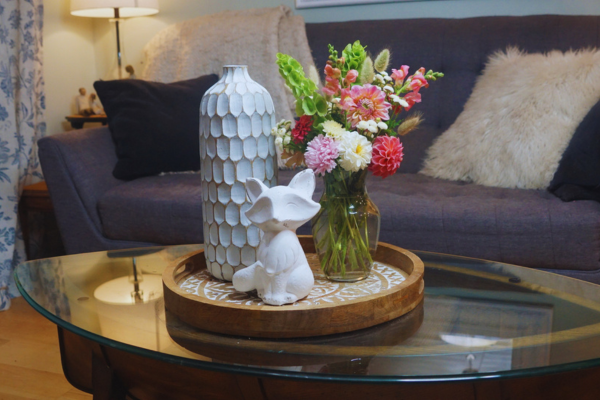
Prepare the Flowers
You’ve removed the packaging. Take a minute to remove any leaves that are going to sit below the water line inside your vessel.
First, take inventory of what you’ve got to work with. Pull the bouquet apart and group the greenery, the larger blooms, and anything tall or unusual.
Build the Arrangement One Layer at a Time
Begin with a loose shape. Grab your tallest stems. Often, bouquets are designed in odd numbers, so you’ll have 3 or 5 of one thing. Place those tallest blooms or the greenery in a way that creates a “frame” of sorts for your arrangement.
Next, add your focal flowers – the ones that immediately catch your eye. Spread them out across the arrangement rather than putting all the showiest flowers together.
Take whatever stems you have left and place them where they’ll fill in the gaps in the arrangement. Maybe you want a wildflower airy look so you’ll have some blooms going in a few different directions. Maybe you’re looking to traditional elegance and are aiming for symmetry. Maybe you’ve got a postmodern vase and you want a quirky, unbalanced piece of floral art. Trust what you love. This arrangement is a reflection of you first and foremost.
Turn the container as you work if the arrangement will be viewed from different angles. Avoid clusters of blooms in one spot. Your eye should move around the arrangement.
If you know you’re likely to spend an hour fussing over the placement of one or two stems, remember: don’t aim for perfection. The small imperfections or quirks are often what make an arrangement feel relaxed, generous, and gathered from the season rather than purchased from a catalogue.
When you’re finished, the arrangement should look like it belongs on the table, not like it’s auditioning for Martha Stewart or Magnolia.
A Quick Tip: Every few stems, set the flowers down and step back. Look at the arrangement from the height that your guests will view it from. Does one side feel empty? Is there one flower sticking out far above everything else? Is there a cluster of blooms in one spot and empty space in another?
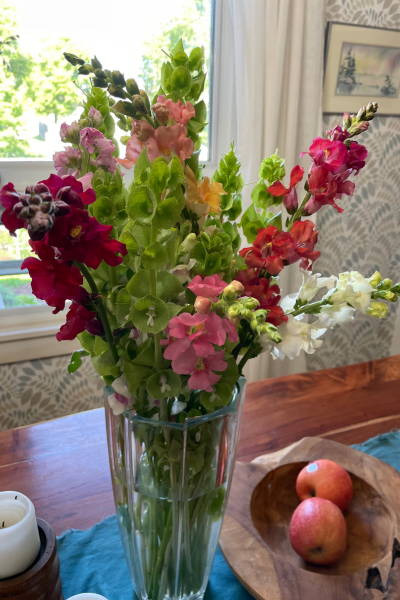
Stop Fussing!
At some point, put down the clippers and stop adjusting. One of the easiest ways to make arranging flowers feel stressful is believing there’s a “correct” way to do it. There isn’t.
If you love how it looks, if it suits your table, and if it makes you smile when you walk into the room, then it’s working. Fresh flowers are meant to bring joy, not anxiety. The arrangements people remember aren’t usually the most technically perfect ones. They’re the ones that feel warm, personal, and full of life.
Lisa and Jenna